Showing posts with label #BCWine. Show all posts

Saturday, January 28, 2012

Supper Clubbing at the Elite.

One of the toughest transitions you'll ever make is the one from big city urban living to small city semi-rural living.  I've been in Penticton for most of the last 16 years and it still surprises me at how hard you have to work to make 'off-season' life stimulating.
In the city we were used to everything being right at our doorstep. There were many times when we would just go 'out', to wander down a busy street and wait until something caught our interest enough to make us pause and perhaps engage. Restaurants, clubs, galleries, shops; all vying for your attention and wallet.
Not so much in Penticton and other small BC interior cities.  You could wander around plenty but all you might engage is a little frostbite.
Now, in the depths of winter and at the end of January, we are at our most susceptible to periods of auto-pilot or Seasonal Affected Disorder (SAD) for the most extremely touched.
That's why when the invitation to participate in this new OkSUPPERClub at the Elite restaurant in Penticton came along was we jumped at it.  The menu, prix fixe, looked adventurous and eclectic. And very reasonably priced at only $25 per person. Who doesn't love to experiment?

Dinner was advertised at 7 SHARP so we politely arrived about 6:45 and were promptly seated.  The kooky, time-machine decor of the Elite amused us as we sipped a couple Cannery Brewing Squire Scotch Ales while watching a silenced The Misfits with Clark Gable, Marilyn Monroe, Eli Wallach and Montgomery Clift on a nearby big screen. Suffice to say, the mood was established. The room filled and it was easily a sell-out. I'm glad I didn't opt for wine.  It would have been nearly impossible to pick a single style to accompany the varied courses that followed.
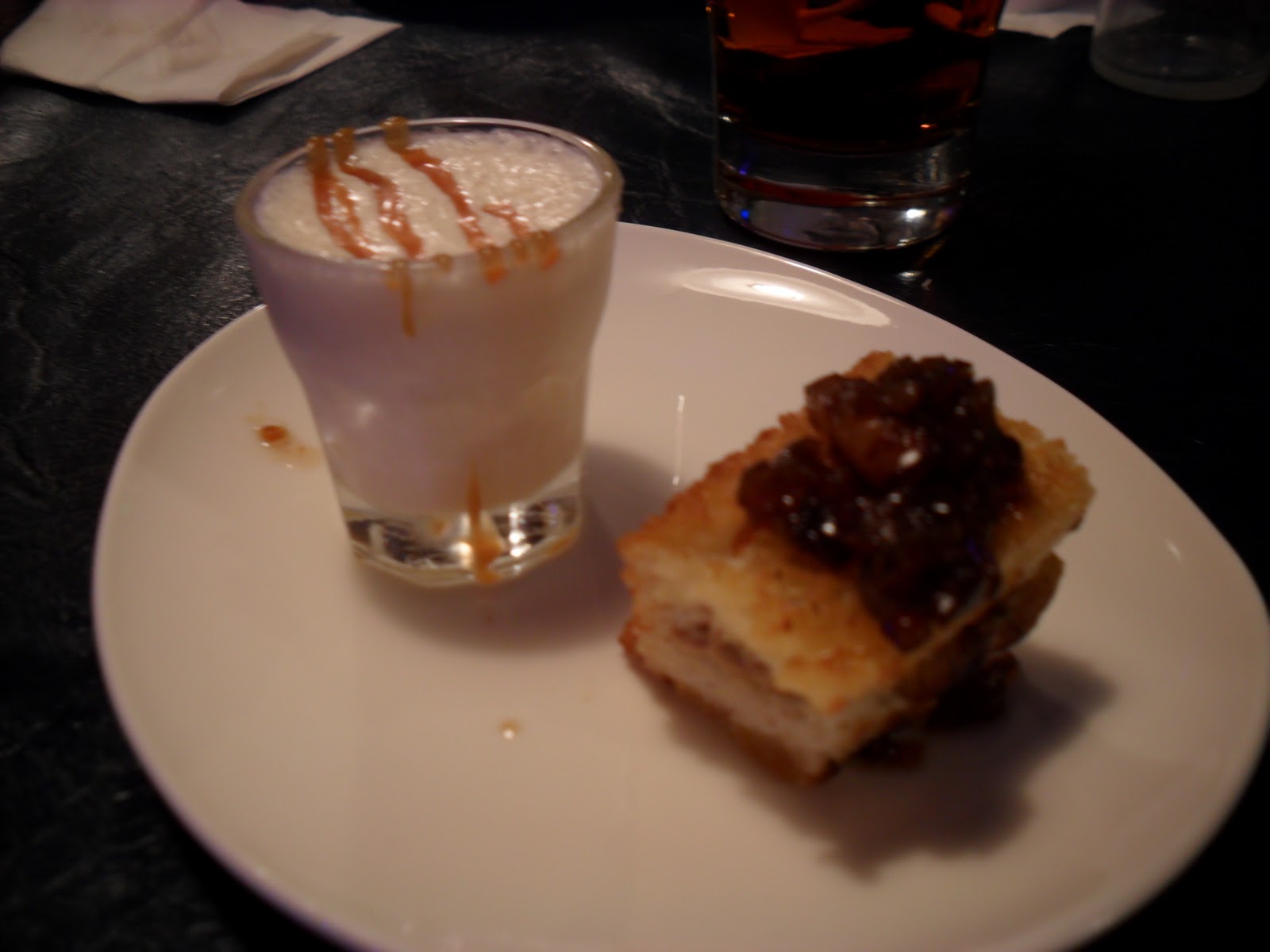
Sometime around 7:30 the first course came out.  It was the Elvis sandwich accompanied by the Bourbon Milk Shake.  The two worked well together.  I'm usually accustomed to this much sweetness at the end of the meal, but in some weird way it all actually performed admirably as a lead course. There wasn't much of description on the menu, and the servers offered no clues, but the peanut butter and banana inside a kind of toast was off-set by what we thought was a very nice carmelized onion relish with a little bacon.  The milk shake was potent; enough to make the shooter-sized glasses very appropriate.  

After a little break, serenaded by a selection of blues, surf and rockabilly oldies, we recieved the Chicken Noodle Soup.  The broth was full and robust, there were ample noodles and vegetables.  It was a perfect blend of home style and innovation.  I could have devoured a big bowl with a loaf of fresh bread and been very happy. 

Just after the soup we received a couple tumblers of home-made root beer.  It takes decades if not generations to get a root beer recipe right.  This one was a gallant attempt, but as explained by the developer, had a few things going against it, not the least was a failure to naturally carbonate.  There were some very vibrant flavours at play but not quite in the right balance.

With only a small delay, the next course arrived.  Billed as the Rick Reuben, it was a chunk of brisket lightly breaded and fried, topped with kind of slaw or kim chee like cabbage preparation, sided with what we guessed was potato salad and a coarse mustard. The pastrami-style brisket was smokey and moist, I would have loved to have this thinly shaved between two pieces of rye. The outer crust was a non starter. I didn't get much from it. The pickled cabbage and veg was not quite kraut, not quite slaw.  It was very piquant, and when you added in the mustard and the brined meat, there was a true battle for vinegary supremacy going on the plate. Apologies for eating a portion before taking the photo. I saw many diners finishing every bit on their plates but for me it was too sharply acidic.

We were then served some very good French fries with a side of gravy.  The fries were done perfectly with an understated spice note added.  The gravy was mild and almost flavourless.

Dessert was banana cream pie.  Many times this classic is prepared with a layer of banana slices somewhere in the pie.  Which is unfortunate because by the time it is served they begin to brown and grow mushy.  Very unappetizing. Not so with this dessert. The bananas were all blended into the cream section, and resting on a dark chocolate cookie crumble crust. Topping the pie was a praline whip cream that was beaten to within a hair of being butter. Top marks for appearance but I tasted an inordinate saltiness in the crust mixture. Loved the rich banana flavour of the filling.

Plenty of fun and a good learning experience for all.  I'm looking forward to the next event. I'd like to see a bit more narrative; either verbally from the servers or written on the menus, about what we are being served and maybe, after the meal,  a Q and A about choices the chef made in his sourcing and preparation.

2010 Fleuvage - Pinot Noir just around the corner.

We're only a couple weeks from bottling the 2010 Black Cloud Fleuvage Pinot Noir. There have been some delays as we wait for the flavours to perfectly fall into place.  We'll be looking at a spring release.

Fleuvage is our essential, fruit-driven Pinot Noir.  It's $19.99 retail and a favourite among restaurants and lounges looking for a medium-bodied red to pour by the glass.

To be first in line to get some by making sure you're on our newsletter list.  We encourage private customers and members of the trade to take advantage of this offer. Just fill out the form below.


Email Marketing You Can Trust

Monday, April 04, 2011

Wine Making and Winery Ownership in BC - A pastime for the wealthy?

After being in this industry for more than 15 years and observing how things work, I'm beginning to suspect that making wine for a living in this jurisdiction is an activity reserved for the rich.
This in itself is not a revelation.
I'm not talking about the day-to-day labour in the cellar or the vineyard.  By wine making I'm suggesting the ownership of land and facilities in order to do so.
It's becoming clear that the regulations for operating and licensing a winery favour those with substantial financial clout and basically keep people of modest means from playing any significant role. I think some of those restrictions have been created for the sole purpose of restricting the number of players in the field and to promote the BC government's long time agri-tourism push.
And this kind of environment limits innovation, new blood and a free market.
Considering the price of land in BC, it would require a minimum of $300,000 just for dirt for a land-based winery license.  That's before equipment, agricultural costs and infrastructure.  One could entertain a 'commercial' winery license, but that's just basically an extension of the BC Liquor Distribution Board's retail system.  You'd miss out on the great system of kick backs given to land-based wineries that produce VQA products.
Next add in the licensing requirement for a 500 case annual production.  This artificial constraint means you'll be looking at a minimum of 8 tons of grapes (about 60 cases per ton) at a cost of somewhere between $1200 to $3,000 per short ton. Let's split the difference at $2100 per ton or about  17 grand right out of the gate.
The point is: if you're a good winemaker who would just like to buy some grapes, make some wine and sell it on the open market: you're out of luck.  
Why should there be some arbitrary number for production? What has that got to do with great wine?

I queried friends in other jurisdictions.  My contact in California knew of no constraint in the size of the operation while in Ontario another friend suggested things may be even worse.

There's no system to allow shoestring operators to simply take part in the market. I propose licensing follow the precedents set be the food industry.  The priorities should be about good sanitation, proper disposal of waste and other environmental concerns in concert with local requirements.  Not some made up number for case production and the requirement for tracts of land that may be the most expensive agricultural land in Canada if not all of North America.
It's time this lazy, bourgeois style of licensing was changed to allow innovative and dynamic new producers.